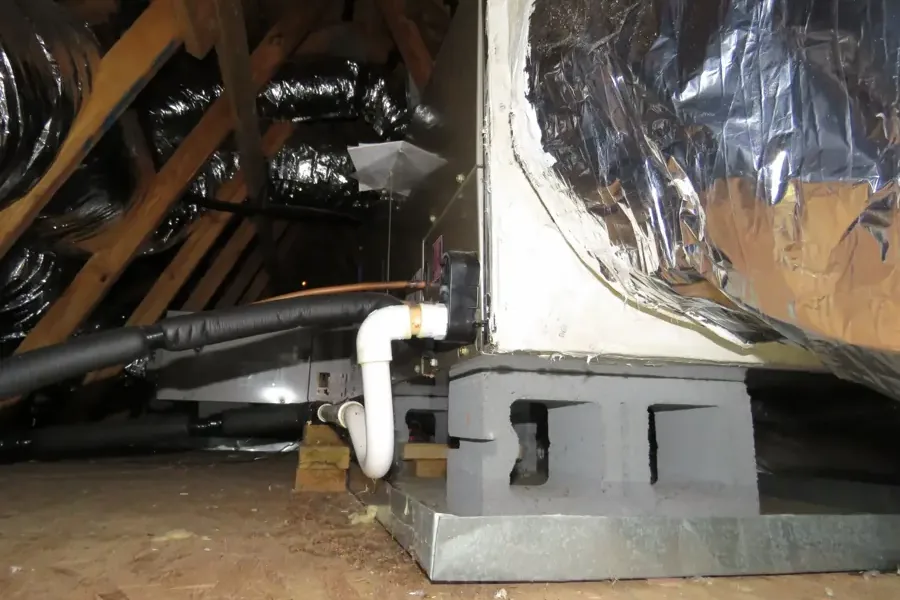
A faint brown ring on a hallway ceiling does not always mean a roof leak. In many newer homes, the cause is the cooling system, which pulls water out of the air all day and sends it down a small drain. When that drain clogs, the water has nowhere to go but through the ceiling.
Key takeaways
- A cooling coil removes water from indoor air, and that water leaves the home through a condensate drain.
- A brown or tan ring on the ceiling below an attic air handler points to a clogged drain or a full drain pan.
- Turning the system off stops new water from forming while the clog is dealt with.
- Collin County sees a July average high of 96 F, so cooling systems here run hard and drains stay busy.
- Wet insulation and drywall above the stain should be dried even if the stain looks small.
How a Condensate Drain Works
As warm indoor air passes over the cold coil in an air handler, water forms on the coil and drips into a pan. A small pipe carries that water out of the house.
Over time, dust, algae and scale can build up inside that pipe. When it clogs, the pan fills and the water spills over.
Why Newer Subdivision Homes See This Often
Most housing here is subdivision construction from the last two decades, and master-planned communities such as Arcadia Farms carry homes from the 2010s and 2020s. Many of those homes place the air handler in the attic.
An attic unit sits directly over finished ceilings, so an overflow has a short drop to drywall. Collin County's July average high of 96 F keeps those systems working through the summer, which means the drain stays wet and active for months.
- Attic air handlers sit above hallway, closet and bedroom ceilings.
- Long runs of drain pipe offer more places to sag and trap water.
- A secondary pan or float switch only helps if it is working.
Reading the Ceiling Stain
The look of a stain tells a lot about its source, and a few details separate cooling system water from other leaks.
Signs that point to the AC drain
A tan or brown ring near the air handler, or along the path of the drain pipe, is a strong clue. Stains that grow during a run of hot weather also point toward condensate.
Signs that point somewhere else
A stain that appears only after rain suggests a roof or flashing problem, which the roof leak water damage page covers. A stain under a bathroom is usually a supply or drain leak from that room.
What to Do When the Ceiling Starts to Sag
A bulging ceiling holds a lot of water, and the drywall can drop without warning. Safety comes before saving the finish.
- Turn off the cooling system at the thermostat to stop new water.
- Stay clear of the area under a sagging or bulging ceiling.
- Set a bucket or tarp below the stain and move furniture away.
- Photograph the stain and the air handler if the attic is safely reachable.
- Keep the attic access closed until the water has been checked for contact with wiring.
How the Ceiling and Attic Are Dried
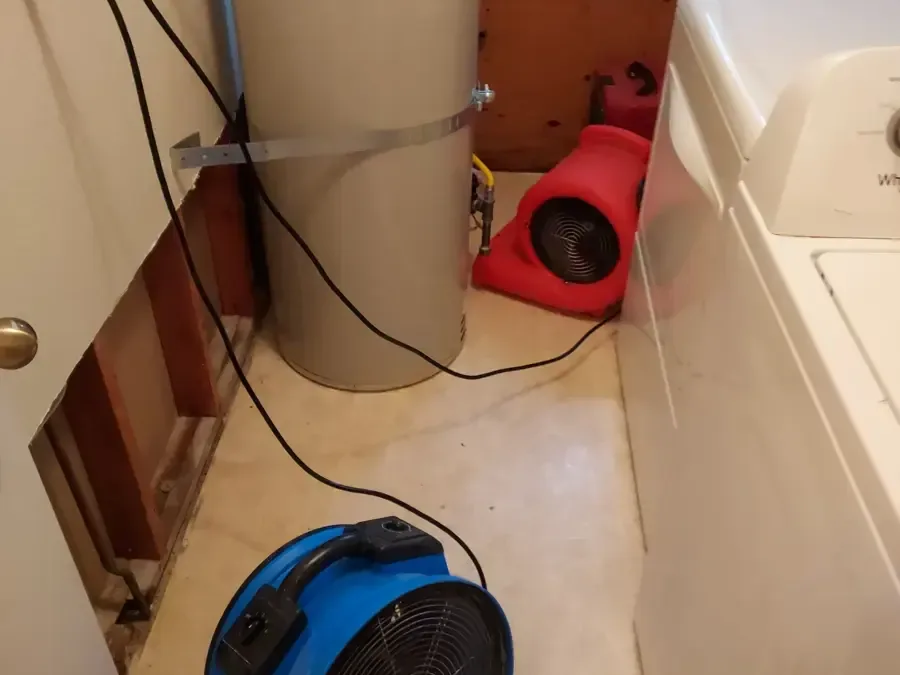
A crew first finds where the water traveled by testing the ceiling, the wall tops and the insulation above it. Wet insulation soaks up and holds water, so it is usually bagged and removed.
Damaged drywall is cut back to dry material, and the open section is dried with air movers and dehumidifiers. The crew then returns to confirm the readings before any new drywall goes up.
The full process is outlined on the ceiling leak water damage page.
What Happens When an Overflow Goes Unnoticed
Condensate overflow is rarely dramatic. A pan can leak a little each time the system cycles, and the water soaks into insulation and the top of the drywall for weeks before a stain appears.
By the time the ceiling changes color, the damp material above it may already be heavy. That weight is what makes a ceiling bulge or drop, and it is why a stain that looks minor can hide a wide wet area.
Wet insulation also stops doing its job, which can raise cooling costs in a hot month while the damp spot grows.
- A faint ring that returns after painting means the source is still active.
- A musty or damp smell in a closet near the attic hatch can signal a slow overflow.
- A hairline crack or soft spot in the ceiling tape often shows before a stain does.
- Water around the base of the air handler in the attic is a clear warning.
A Simple Check at the Start of Cooling Season
With a July average high of 96 F, a cooling system in Collin County is rarely idle. A short check early in the season costs little and can save a ceiling.
The goal is to confirm that water leaves the pan and that the safety switch works before the heavy months arrive.
- Look at the pan under the air handler for standing water or rust.
- Pour a small cup of water into the pan and watch that it drains.
- Test the float switch by lifting it and confirming the system stops.
- Look at the ceilings below the unit for any new tint or texture change.
Keeping the Drain Clear
A clog usually forms slowly, so small habits are enough to prevent most overflows. A technician from the air conditioning company can flush the drain during a tune-up.
If standing water has already spread into other rooms, a team for emergency water removal extracts it before drying starts.
- Replace filters on schedule so less dust reaches the coil.
- Have the drain flushed and the pan checked at a seasonal tune-up.
- Install a float switch that shuts the system off when the pan fills.
- Check the ceiling below the unit during the first hot weeks of the season.
Questions
How can a homeowner tell an AC stain from a roof leak?
Stains near the air handler that grow in hot weather point to condensate. A stain that shows up only after rain points to the roof.
Should the cooling system stay on during a leak?
No. Running it keeps producing water, so turn it off at the thermostat until the drain is cleared.
Can a small stain hide a bigger problem?
Yes. Insulation and drywall above the stain can be wet even when the visible ring is small, so moisture readings are taken before anything is covered.
Is the water from an AC drain clean?
It starts as condensation, but it picks up dust and algae from the pan and the pipe. It is treated with more care than a clean supply leak.
When is a ceiling cut open?
When moisture readings stay high or the drywall is sagging, soft or bubbled. Dry drywall with only a surface stain can often stay.
Can a clogged condensate drain cause damage inside walls too?
Yes. Water that escapes the pan can run down framing and into wall cavities, so moisture readings are taken in nearby walls as well as the ceiling.